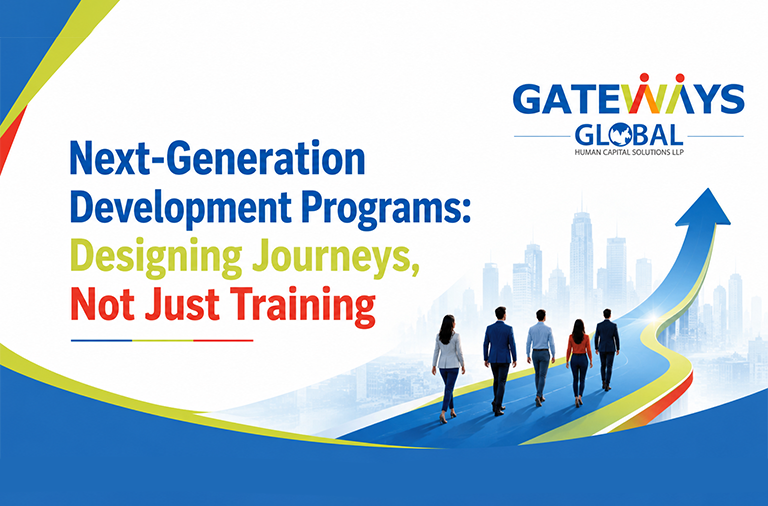
The future of Learning and Development should move from offering more training programs to creating relevant development experiences that generate capability, confidence, and organizational impact. Talent development of the future is about creating development journeys — long-term, personalized journeys that help people grow over time.
Today’s business environment demands a different approach. Development needs to be continuous, individualized, and strongly tied to organizational objectives. It should enable employees not only to learn new skills but also to apply them effectively, embrace change, and grow in line with the evolving needs of the business.
The first step in a development journey is to have a clear understanding of both business and personal development goals. Instead of assuming that questions of training should be answered with “What should we teach?”, questions of capability should be: “What should we develop, and how can we support employees throughout this journey?” This subtle change turns learning from an individual event into a long-term investment strategy.
The programs that make the greatest difference are shaped by a variety of learning experiences. While formal learning offers content and substance, growth occurs through challenging assignments, coaching and mentoring, peer collaboration, action-learning teams, and regular feedback. Employees benefit most when given the opportunity to apply new skills to actual business challenges while receiving coaching and support from others throughout the journey.
Technology is also redefining how development journeys are designed. With the help of platforms based on artificial intelligence, learning analytics, and adaptive platforms, organizations can offer personalized learning paths in accordance with employees’ roles, competencies, and career goals. Employees are provided with personalized learning recommendations, practice opportunities, and resources that are relevant to their growth areas rather than a generic program for everyone.
Equally important is the role of managers. Development is no longer the sole responsibility of the Learning and Development department. Managers create opportunities for growth, encourage experimentation, provide recognition and feedback, and support employees as they apply new skills. Their coaching helps transform learning into sustained performance improvement.
Organizations need to reimagine ways to define success. Completion rates and training hours provide only partial information. The true measure is higher employee engagement, improved performance, stronger leadership pipelines, increased internal mobility, and the ability to adapt to evolving business needs. Measuring capability growth and linking development outcomes to business impact helps demonstrate the value created by development initiatives.
Inclusion and employee ownership are also key tenets of next-generation development programs. Career conversations, accessible learning resources, and flexible learning pathways enable employees to articulate their personal growth opportunities and help ensure fair access to development opportunities across all talent groups.
In the end, the ones that will succeed are the ones that will no longer treat development as just training, and instead create meaningful learning journeys. Such journeys not only connect learning with purpose, performance, and career growth but also create an environment in which employees grow with the business.
The future of work is in a constant state of evolution, and one thing is becoming more apparent: great organizations do not simply deliver training; they create experiences that help people become the professionals and leaders they are capable of becoming.
At GatewaysGlobal, this philosophy is guided by the ICI Principle—Inclusive, Consensus, and Implementable.
Inclusive development recognizes that growth opportunities should be available to everyone, not only high-potential employees or senior leaders. Each person brings unique experiences, perspectives, and aspirations.
Consensus helps to ensure support for development priorities. These priorities are shaped collaboratively by business leaders, managers, and employees, ensuring that they reflect practical business realities while also addressing individual development needs.
Most importantly, learning must be Implementable. Knowledge has little value unless it translates into action. Through coaching, mentoring, action-learning projects, and stretch assignments, concepts are transformed into capabilities, and capabilities into measurable performance outcomes.
The question for every leader is no longer “How many people did we train?” but “How many people did we truly help grow?”